
Fiber Optic HDMI Cable OEM Solutions for High-Performance AV Systems
2026-11-16
In high-performance AV setups, every signal detail matters—yet the cable often becomes the weakest link. Fiber optic HDMI technology is changing that, delivering uncompressed 4K/8K video, low latency, and immunity to electromagnetic interference over distances that copper simply cannot handle. For integrators, installers, and brands looking to differentiate, the challenge is finding a manufacturing partner that can match this performance with consistency and customization. That’s where EBCYX stands out. With deep OEM expertise and a focus on reliable, high-bandwidth fiber optic HDMI solutions, EBCYX helps you build AV systems that perform flawlessly from source to display—without the usual compromises.
Where Copper Falls Short in High-Bandwidth AV Systems
Running 4K/120 or 8K video over copper often turns into a game of inches. Attenuation climbs fast once the signal travels more than a few meters, and the cable begins working against itself. Skin effect and dielectric losses smear the fast edges of the signal, which shows up as sparkles, intermittent dropouts, or a blank display that no firmware update can solve.
Interference adds another layer of trouble. Copper readily picks up noise from nearby motors, Wi-Fi routers, and switching power supplies, and once that noise couples onto the line it travels right along with the AV data. Shielding offers some protection, but it also makes the cable thicker, heavier, and harder to pull through conduit or tight wall cavities. In practice, high-bandwidth HDMI and DisplayPort runs over copper usually hit a hard ceiling around five to ten meters before active electronics or fiber become the only sensible choices.
There is also the mismatch between cable specs and real installations. Each step up in resolution or refresh rate pushes copper closer to its electrical limit, leaving almost no margin for long paths, sharp bends, or field-terminated connectors. Installers often see failed link tests and repeat service calls even when the cable meets the printed specification.
Custom Fiber Optic HDMI Assemblies for OEM Integration
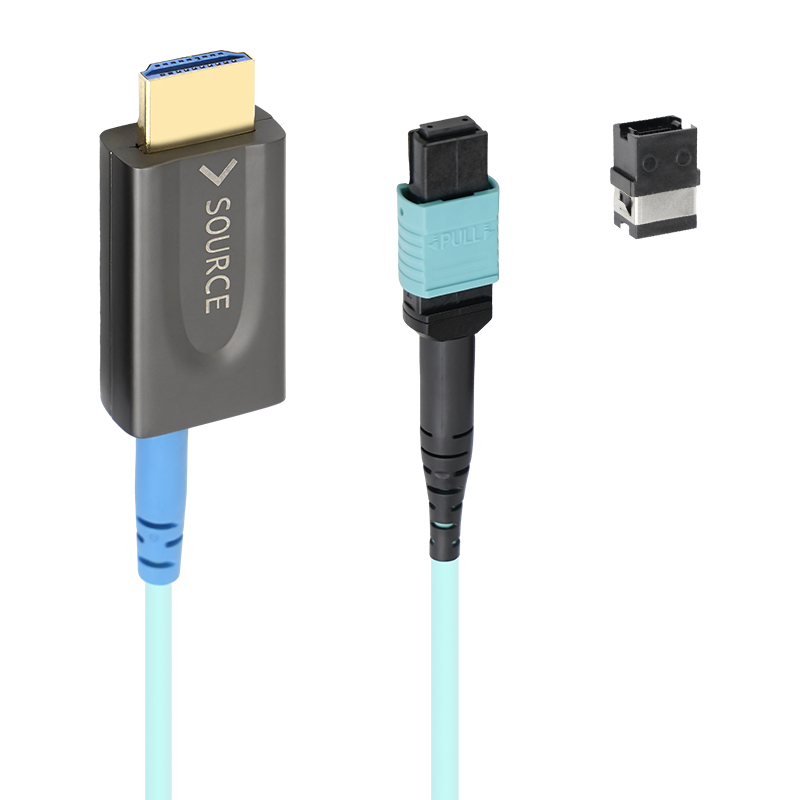
Fiber optic HDMI assemblies built for OEM use rarely start from a fixed drawing. The conversation usually begins with the distance between the source and the display, the available bend radius inside the enclosure, and whether power needs to travel alongside the optical fibers. From there, jacket material, connector orientation, pull tabs, and labeling can all be adapted without forcing a generic cable into a space it was never designed for.
A hybrid design often makes more sense than a fully optical link. By keeping a small number of copper conductors for low-speed control signals and adding fiber for the high-bandwidth video path, the assembly stays thin and flexible while still locking into standard HDMI connectors. This approach helps with latency, power budgets, and EMI in tight medical or broadcast equipment where every millimeter and milliwatt counts.
The practical value shows up during the build, not just on the datasheet. Custom lengths, pre-terminated ends, tested insertion loss, and serialized lot tracking mean the assembly can move from prototype to production without surprises on the floor. When the cable arrives ready to install, it removes one more variable from system integration instead of adding to it.
Maintaining 8K Signal Integrity Over Long Cable Runs
Getting 48Gbps down a short HDMI cable is one thing. Stretching that same 8K signal across a conference room or through a wall plate introduces a completely different set of problems. Signal loss starts compounding fast, and without proper attention to cable construction, impedance stability, and active equalization, you end up with sparkles, dropouts, or a blank display that nobody can diagnose over the phone.
The first rule is to respect the physical limits of the medium. Pure copper HDMI cables usually top out around three meters for reliable 8K/60 with full chroma. Beyond that, you need either an active optical cable or a hybrid design that carries the high-speed data lanes over fiber while keeping copper only for low-speed control and power. But even AOC cables aren't magic; their internal transceivers and bend radius tolerances vary widely between manufacturers, so a cable that works perfectly laid flat on a test bench can fail when it's pulled through conduit with a sharp turn at the rack.
For permanent installations, consider a different approach entirely: convert the signal to something that travels better. HDBaseT or IP-based distribution over shielded Cat6A or fiber removes the distance limitation from the HDMI handshake altogether. The trick is choosing converters that don't downconvert or compress the signal in ways that undermine the 8K advantage, and then verifying the full path—source, wall plate, cable run, converter pair, display EDID—as one system rather than trusting individual components. A simple all-ones pattern looped for an hour will catch more real-world failures than any spec sheet comparison.
Connector Engineering and Stress Relief in Harsh Installations
Most connector failures in rough service never start at the mating face. They begin at the cable entry, where a sharp bend or a poorly supported harness turns vibration into a steady pull on crimp barrels and solder cups. A backshell with a proper saddle clamp, placed a short distance behind the shell, often does more for reliability than upgrading the contact material. The idea is to give the termination a quiet zone: keep the cable jacket clamped before it can transfer tension into the contacts, and route the conductors so they approach the pins without side load.
There is also a difference between holding a cable and fighting it. Rigidly lashing the last meter of cable to a vibrating structure can send every pulse straight through the gland and into the connector body. A small service loop, a flexible strain-relief boot, or a segmented backshell can break that mechanical path while still controlling movement. In high-shock or thermal-cycling installations, potting the rear cavity can stabilize the terminations against micro-fretting, but only if the cable is still allowed to flex somewhere upstream.
Material choice matters, but installation geometry usually matters more. Fluorosilicone seals and plated shells will not save an assembly that is forced into a radius tighter than the cable manufacturer allows, or that hangs its weight from the connector body. Dressing the last meter with proper clamp spacing, watching the bend radius, and keeping the connector shell from acting as a cable anchor are the details that keep stress away from the electrical interface.
Hybrid AOC Designs That Simplify Power and Routing
Active optical cables often struggle with dense board layouts because their power and signal traces compete for the same limited routing space. Hybrid AOC designs step in by moving the electrical-to-optical conversion closer to the connector edge, which trims the number of long, lossy copper runs. Instead of forcing every high-speed lane through a single crowded break-out region, the hybrid approach lets power enter on shorter, dedicated paths while optical fibers handle the bulk of the data movement. This separation reduces layer count and leaves more room for decoupling capacitors near the transceiver, cutting down on the usual headaches of impedance mismatches and ground bounce.
A practical benefit shows up when you compare a traditional paddle-card AOC to a hybrid version with an embedded VCSEL driver and TIA on a small rigid-flex section. The conventional layout might need four or more layers just to fan out differential pairs around power islands, whereas the hybrid can often drop to two or three layers because the optical engines sit where the electrical signals already terminate. That frees up routing channels for supply rails, and it also shortens the return path for high-frequency currents. Engineers can then place bulk capacitance directly under the connector instead of scattering it along a meandering power trace, which keeps the eye diagram cleaner without resorting to expensive low-loss laminates.
Another overlooked advantage is how hybrid AOC geometry simplifies manufacturing tolerances. When the electrical and optical interfaces are separated early, the fiber ribbon no longer has to follow the same bend radius constraints as the copper flex. That means the cable assembly can use a stiffer, lower-cost substrate for power delivery and a softer, more flexible section for the fiber breakout. The result is a cleaner assembly that snaps into place rather than fighting the board, and it lets designers avoid the classic trade-off between electrical integrity and mechanical strain relief.
Quality Validation and Compatibility Testing for AV Installers
Most AV installers learn early on that a spec sheet only tells part of the story. A matrix switcher may claim 4K60 4:4:4 support, but pairing it with an older display or a budget HDMI cable can expose handshake failures, dropouts, or washed-out colour. Quality validation here means testing the exact combination of sources, extenders, scalers, and panels that will live on site, not just relying on manufacturer promises.
Compatibility testing goes beyond plugging gear together on a bench. We check EDID behaviour across firmware revisions, confirm that CEC commands do not trigger unexpected input jumps, and run long-duration signal tests to catch intermittent faults. Audio return channel setups, HDCP version mismatches, and multi-channel PCM over ARC often fail only after the room is closed up, so these get probed before any trim is installed.
For installers, this step also shapes documentation. When a receiver, projector, and control system pass validation together, the exact cable lengths, firmware versions, and input labels go into the handover notes. That turns a one-off success into a repeatable build and saves return visits when the client swaps a source or updates a streaming box.
FAQ
They carry signals over much longer distances without degradation and are immune to electromagnetic interference, so they hold up well in crowded racks or venues with lots of equipment.
Yes. Manufacturing can include custom lengths, connector orientation, branding, color, and packaging, which helps integrators and brands match the cable to the rest of their hardware.
Large auditoriums, medical imaging suites, broadcast studios, control rooms, and high-end home theaters tend to benefit because they often require long, clean signal runs where copper struggles.
Current designs typically handle 4K and 8K video with high refresh rates, along with HDR, deep color, and advanced audio formats, but exact specs depend on the chipset and cable generation.
They are generally thinner and more flexible than copper HDMI cables, and the fiber core allows tighter bends, though you still need to respect the minimum bend radius to avoid damaging the glass.
Reliable suppliers test each cable for optical power, signal integrity, and connector durability before shipment, and batch-level reports can be shared with the buyer.
They draw a small amount of power from the HDMI port through the connector electronics. In most cases no separate power adapter is needed, but some very long runs or certain sources may benefit from a powered adapter.
Look for a partner with in-house optical termination, flexible minimum order quantities, fast sampling, and a clear process for engineering changes or custom labeling.
Conclusion
Copper HDMI cabling starts to struggle once data rates climb and runs stretch beyond a few meters, with dropouts and sparkle artifacts becoming common in 8K workflows. Fiber optic assemblies built for OEM use avoid that ceiling by carrying high-bandwidth video over much longer distances without signal repeaters or equalizers. Working directly with a manufacturer to specify cable length, jacketing, and connector orientation lets integrators fit the link to the product instead of forcing the product around a stock cable. In fixed installations and production environments, this approach also helps preserve color depth and frame timing, so 8K signals stay stable from source to display even when the cable path is far from straight.
The mechanical side matters just as much as the optical path. Reinforced connector bodies, strain relief boots, and pull-resistant jackets reduce failures in conference rooms, broadcast racks, and rental staging where cables are repeatedly connected or routed through tight spaces. Hybrid active optical cable designs keep copper conductors only where they are needed for low-current power, which simplifies hookups and avoids bulky external power injectors. Before these OEM solutions ship, compatibility testing across switches, extenders, and display chipsets catches handshake and EDID issues early. That leads to a more predictable installation, fewer service calls, and a cable that fades into the background of a high-performance AV system.
Contact Us
Contact Person: David Yang
Email: [email protected]
Tel/WhatsApp: 8615814734054
Website: https://www.ebcyx.com/