
China 380V Vibrator Motor Selection Guide for Heavy-Duty Applications
2026-11-16
Selecting a 380V vibrator motor for heavy-duty applications often feels like a gamble between torque, durability, and heat dissipation. Most guides repeat the same generic specs, but real-world performance depends on details that rarely make it into standard datasheets. Whether you're driving a large hopper, a screening deck, or a compaction table, the motor must handle prolonged vibration without loosening its own mounting bolts or overheating under continuous load. In this guide, we move beyond basic wattage and RPM ratings to examine the factors that separate a dependable workhorse from a costly failure. We'll also highlight why Guangling has gained traction among engineers who need certified performance and consistent build quality in demanding environments. From insulation class to eccentric force adjustment, here's what actually matters when matching a 380V vibrator motor to heavy-duty duty cycles.
Starting Torque Demands That Separate Heavy-Duty Models from Standard Units
Breakaway torque is where the difference first shows up. A standard motor may be sized to handle a steady running load without trouble, but heavy-duty equipment often sits under packed material, cold hydraulic fluid, or a loaded belt. The instant the switch closes, the motor has to overcome static friction and inertia that can easily be double or triple the normal operating demand. If that initial twist is not there, the shaft barely moves, protection trips, or the machine just growls and overheats.
Heavy-duty models are not simply standard frames with a higher number on the nameplate. They get larger rotor mass, reinforced shafts, and bearing arrangements that stay aligned when torque comes on hard. Those mechanical upgrades allow the motor to deliver sustained locked-rotor and pull-up torque without flexing, rubbing, or transferring excessive heat into the windings. Standard units often reach the same running horsepower, but they lack the structural margin for repeated starts under severe load.
The real cost of ignoring this difference appears in the first few seconds of every start. Couplings wear, belts slip, and windings run hotter than expected, which shortens life even when the motor never trips. Heavy-duty equipment is built for that harsh moment again and again, so its starting torque is treated as a design requirement rather than a temporary overload.
Reading the Duty Cycle Before You Oversize the Motor
Many teams reach for a larger frame the moment a motor runs warm, but heat builds over time, not instantly. A motor rated for intermittent duty can handle short bursts well above its continuous rating if it gets enough idle time to shed heat. Reading the duty cycle first tells you whether that temperature spike is actually a problem or just normal behavior for a stop-start application.
Look at the load profile before adding horsepower. A crusher that jams for three seconds and then coasts for twenty has a very different thermal demand than a fan running flat out for ten hours. Oversizing for a brief peak often adds cost, weight, and inertia without solving anything; the extra mass can even lengthen acceleration time and stress couplings.
Match the duty type to the real pattern rather than the worst-case moment. If the cycle is mostly light with a hard push every few minutes, a standard motor with proper service factor may be enough. If the peaks repeat faster than the rotor can cool, then a larger frame or forced cooling makes sense. The nameplate and application notes usually give enough to decide, but only if you actually read them before quoting a bigger motor.
Why Winding Insulation Class Matters More Than Wattage
People often get fixated on wattage when comparing motors or generators, but that number tells you very little about how long the unit will survive under real load. The winding insulation class is a far better predictor of thermal endurance. It determines the maximum internal temperature the copper windings can withstand before the enamel begins to degrade, crack, or short out. A higher wattage rating with a low insulation class simply means the machine can cook itself faster under peak conditions.
Class F and Class H insulation, for instance, allow for continuous operation at 155°C and 180°C respectively, while Class B tops out around 130°C. That extra 25 to 50 degrees of headroom isn't just a technical detail; it directly translates into fewer unexpected shutdowns, longer service intervals, and a machine that doesn't need to be babied during voltage dips or heavy starting loads. When you see a motor rated for impressive watts but only Class B insulation, you're looking at a unit that will likely need re-winding much sooner than a modestly powered Class H model doing the same job.
In practice, choosing based on insulation class means you're buying thermal margin rather than peak output. That margin absorbs the spikes caused by poor ventilation, high ambient temperatures, dust build-up, or frequent starts and stops. Wattage might grab your attention on a spec sheet, but the insulation class tells you whether that power can be delivered reliably for years instead of months.
Matching Base Mounting and Bolt Patterns to Existing Equipment
Field measurements almost always tell you more than a manual or a nameplate. Before ordering anything, check the actual center-to-center spacing of the mounting holes, the hole diameters, and whether any holes have been wallowed out or repaired in the past. Small deviations of a millimeter or two can put the fasteners in a bind even when the pattern looks correct at a glance.
A pattern can appear standard but still have subtle differences such as metric holes paired with an inch-based bolt circle, a shallow counterbore, or an off-center locating boss. Making a quick template from heavy cardstock or thin plywood helps catch those mismatches early. Mark each opening clearly, check the thread pitch, and never force bolts into place just to make the pattern line up.
When a direct match is not available, an adapter plate is usually safer than drilling into existing equipment. Use a plate thick enough to resist flexing, leave room for recessed fasteners, and add dowel pins or stepped holes where alignment needs to repeat. Test every hole with the original hardware before final assembly, then tighten gradually in a diagonal sequence to keep the load even.
Adjustable Eccentric Weights and Fine-Tuning Force Output
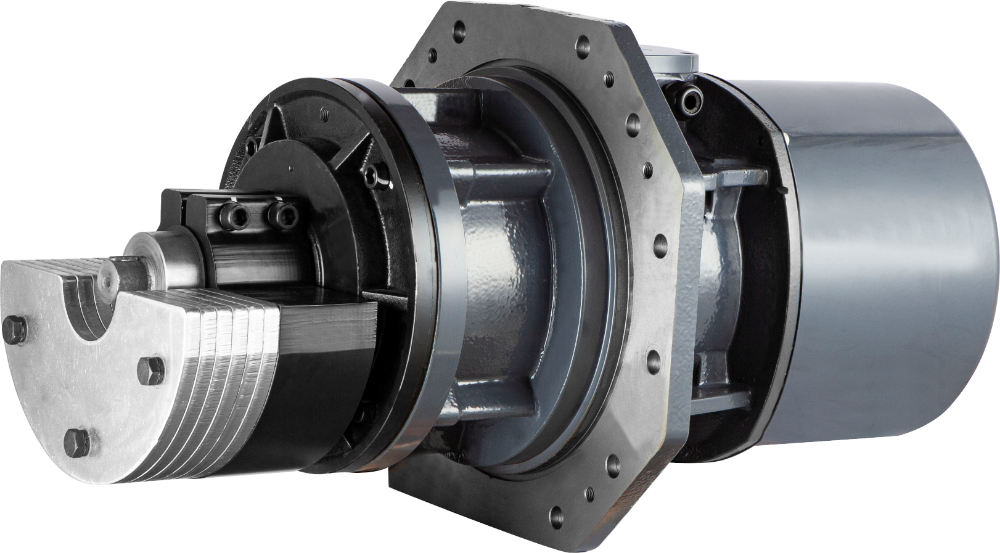
The real value of adjustable eccentric weights on a vibratory driver or screen shows up when material conditions change. Moving the counterweights relative to each other shifts the center of mass, which changes the force vector without swapping out major components. That kind of adjustment is useful for handling damp, dense, or irregular feed because the machine can be pushed toward a sharper stroke or a broader vibration pattern depending on what actually moves the material.
Fine-tuning the output is rarely a one-step process. It usually begins with a rough angle change on the weights, followed by short test runs to read the machine under load. Both ends of the shaft need to stay in sync; even a small mismatch can create a wandering motion, uneven bearing wear, or a stroke shape that looks fine on paper but performs poorly in the real feed bed. Experienced operators often make changes in small increments and listen for changes in noise as much as they watch the amplitude.
Rather than relying only on a manufacturer's setting chart, it helps to note the weight position, drive current, and material response for each job. Frame stiffness, spring condition, and feed rate all influence the actual output, so those records become more accurate than a generic curve after a few real runs. A clear mark or photo of the adjustment point also avoids confusion when the original stamping gets worn or dirty over time.
Supply Voltage Tolerance and Real-World Site Conditions
Field measurements rarely match the numbers printed on a transformer nameplate. A motor rated for 400 V may sit at the end of a long cable run where the actual terminal voltage sags to 370 V during peak load, or it may sit close to a tap changer that pushes the supply up to 430 V on a quiet Sunday. Supply voltage tolerance therefore has to be treated as a range that drifts with time of day, utility switching, and the impedance of the site wiring itself, not as a single value to be checked once at commissioning.
That drift matters because many pieces of industrial equipment tolerate only a narrow band before their behavior changes. An induction motor running at 10% under voltage draws more current to maintain torque, which raises winding temperature and shortens insulation life. At 10% over voltage, magnetic saturation can push no-load current up sharply and cause nuisance tripping of protective relays. In both cases the real question is not whether the supply is within the utility's stated tolerance, but whether the combined effect of voltage variation and local site conditions keeps the equipment inside its own operating envelope.
Site conditions often amplify what would otherwise be a minor deviation. High ambient temperature reduces a cable's current-carrying capacity while voltage drop increases with conductor temperature. Unbalanced phases, harmonic content from nearby drives, and poor neutral grounding can make the effective voltage at the terminals even less stable than a simple RMS reading suggests. For this reason, a practical site assessment should record voltage over several days under different load patterns, and compare those readings against the equipment's tolerance at its actual operating temperature rather than against a generic supply standard.
FAQ
Start with the bulk material weight and the chute or hopper dimensions, then calculate the required force based on the material flow characteristics. For stubborn materials like wet sand or compacted fines, select a motor with at least 20 to 30 percent more force than the calculated value so the unit does not run at full load constantly.
Three-phase 380V supplies produce a smoother rotating field and lower current draw for the same output, which reduces stress on contactors and cables. In heavy-duty installations that run for long shifts, this makes motor protection simpler and helps avoid voltage drop problems that are common with long cable runs.
Look for an IP66 or higher enclosure to keep out fine dust and water spray, and choose Class F or Class H insulation if the motor will run in high ambient temperatures. For washdown areas, stainless steel hardware and sealed cable entries matter just as much as the enclosure rating because standard fasteners can corrode before the motor itself fails.
Many manufacturers produce frames that match common international foot mounting dimensions, but interchangeability should not be assumed from voltage alone. You need to compare the bolt hole spacing, shaft height, and terminal box position against your existing equipment because small variations in the mounting flange or foot pattern can delay installation.
Most early bearing failures come from regreasing with the wrong grease or running the motor below its minimum speed with a variable frequency drive. Use a high-quality grease specified for vibratory loads, follow the manufacturer's relubrication interval instead of guessing, and avoid prolonged operation at low frequency unless the motor is explicitly rated for inverter duty.
It depends on the working point and the number of poles. A two-pole motor gives high frequency and low amplitude for screening, while a four-pole or six-pole unit typically suits feeders and hoppers that need larger stroke at lower frequency. A single model can sometimes cover similar duties, but using one motor across very different equipment usually forces a compromise in stroke and force.
Provide the equipment type, total vibrating weight, material bulk density, desired stroke or amplitude, available voltage and frequency, ambient temperature, and whether the motor will be controlled by a variable frequency drive. Also mention the mounting position and space constraints because a motor that fits electrically may still be impossible to install in the existing frame.
High ambient temperature reduces the margin between the motor's normal operating temperature and the insulation limit, so a Class F motor may need to be upgraded to Class H or derated for continuous service. In hot regions or enclosed process areas, allow for additional cooling space around the motor and avoid placing multiple units too close together because recirculated hot air shortens insulation life.
Conclusion
Heavy-duty vibrator motors running on 380V in China rarely fail because of a single rating on a datasheet. The first thing worth checking is whether the locked-rotor and pull-up torque can handle the start under a full material load, since standard units often stall exactly where a bulk hopper or shakeout deck needs the most force. Alongside that, duty cycle should be read as a thermal limit rather than a convenience label. A motor marked for intermittent operation will overheat quickly if the process runs longer than expected, so oversizing is not the safest fix; selecting the right S1 or S4 rating is what keeps the winding from cooking.
Winding insulation class tends to reveal more about long-term survival than wattage does, especially when ambient temperatures climb or the supply voltage drifts away from 380V. A Class F or H insulation gives the extra thermal margin that a higher wattage alone cannot provide. The mechanical side matters just as much: mounting footprint, bolt spacing, and shaft height need to match the existing frame, or installation becomes a series of makeshift spacers and re-drilled holes. Finally, adjustable eccentric weights are useful for fine-tuning the force output without changing the motor, and the supply voltage tolerance should be checked against real site readings before commissioning. That combination of torque, duty cycle, insulation, mounting, and tuning is what separates a reliable heavy-duty selection from one that only looks correct on paper.
Contact Us
Contact Person: ZHUO
Email: [email protected]
Tel/WhatsApp: 86-576-86320988
Website: https://www.cnguangling.com